
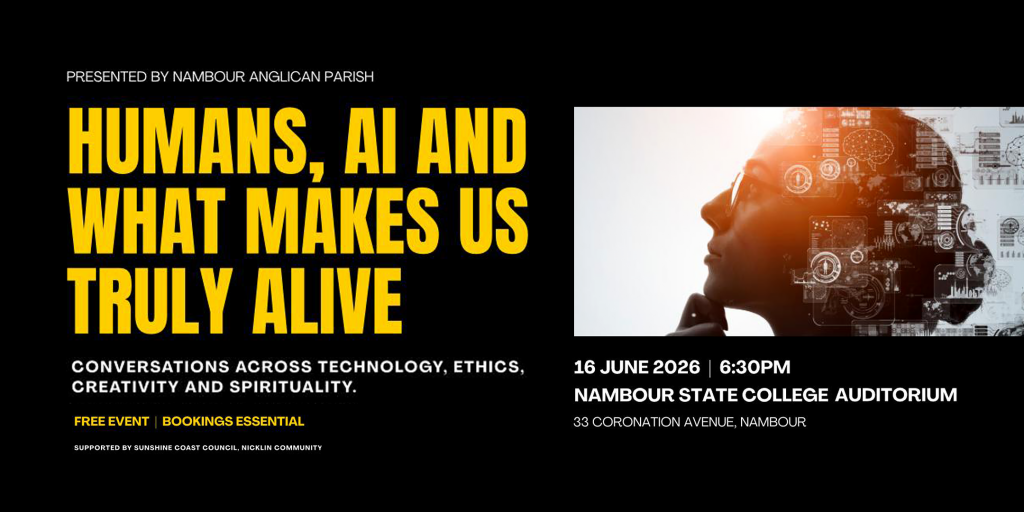
Humans, AI and What Makes Us Truly Alive sparks reflection and deep conversation with Nelson Eulalio and other guest speakers
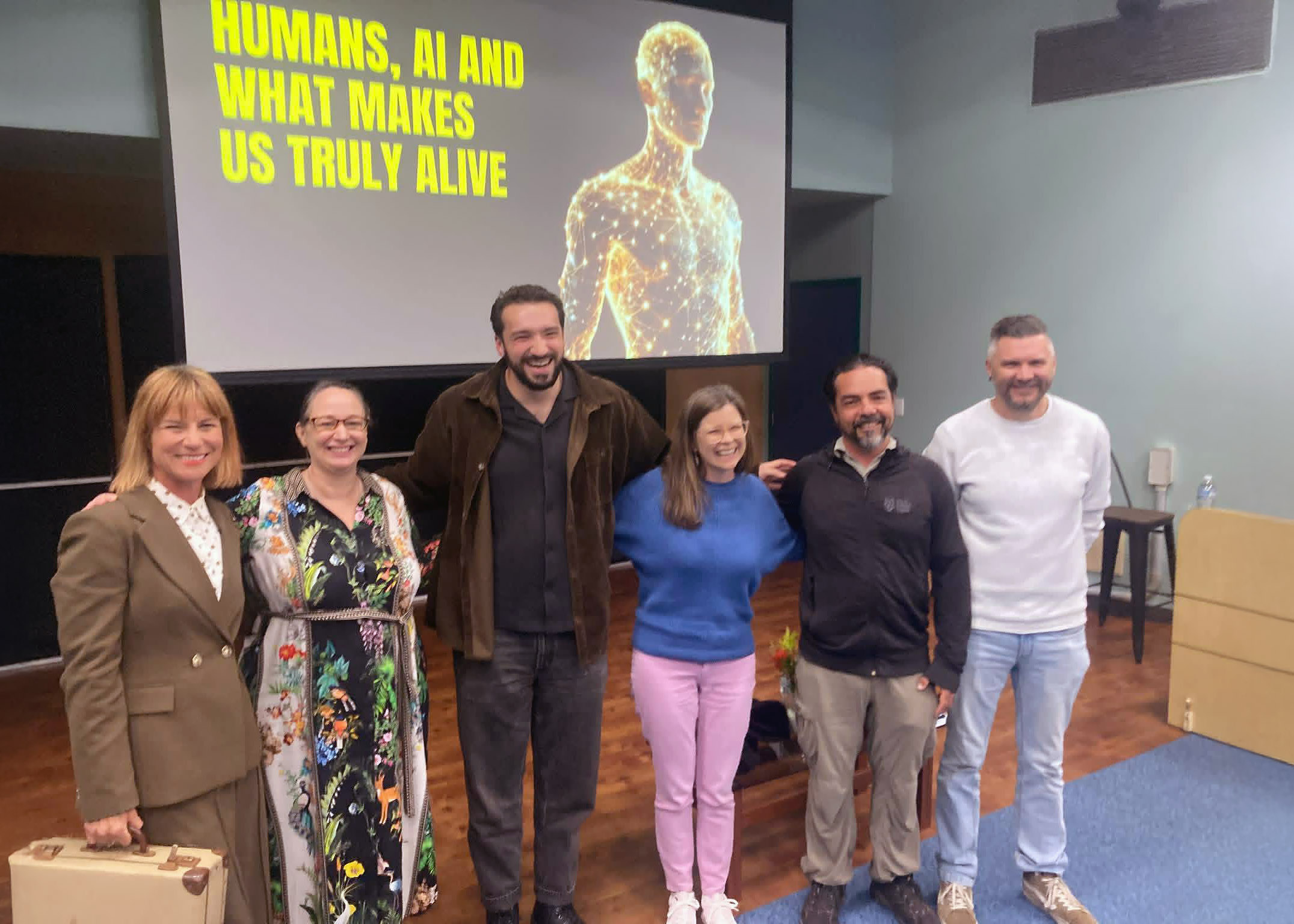
A thoughtful crowd gathered at the Nambour State College Auditorium on Tuesday, 16th June 2026, for “Humans, AI and What Makes Us Truly Alive – Conversations across technology, ethics, creativity and spirituality”, an event that explored one of today’s most pressing questions: how do we remain deeply human in an age of artificial intelligence? Our founder Nelson Eulalio participated as a guest speaker, as well as other important names who blended ideas from technology, psychology, spirituality and community life; the evening offered more than just discussion—it became a space for reflection, challenge and inspiration.
OPENING
Opening the event, Lydia Fairhall, a First Nations Anglican priest, artist and executive leader, invited the audience into a deeper kind of conversation—one that went beyond innovation and into meaning. The opening brought remarks and reflections on the rapid advancement of artificial intelligence, noting that AI is already far more capable than many people realise and continuing to evolve at an accelerating pace. Lydia suggested that we are approaching a moment in history where human intelligence may no longer be the primary measure of our value.
In that context, the event brought a powerful question: what remains uniquely human? The reflections pointed toward qualities that cannot easily be replicated by machines—connection, presence, belonging, creativity, community and a sense of wonder. These are the aspects of human life that give depth and meaning beyond efficiency or output, and they form the foundation of how we relate to one another and the world around us. Rather than centring fear, the strongest thread running through the evening was a call to reclaim humanity in an age of acceleration. It was acknowledged that AI will likely both enhance and diminish human life, offering new possibilities while also introducing risks. Crucially, she warned that ignoring these changes increases the potential for harm, manipulation and disconnection, encouraging ongoing engagement and awareness.
The program continued with a screening from the 2026 Wisdom & Action Forum, featuring Audrey Tang, Taiwan’s former digital minister, in conversation with AI expert Toby Walsh, Scientia Professor of Artificial Intelligence, UNSW. Their exchange highlighted the growing importance of trust, transparency and public involvement in shaping AI systems. It reinforced the idea that technology is not neutral—and that collective responsibility will determine whether it ultimately benefits or harms society.
LIVE PANEL
The live panel discussion brought together a diverse group of voices:
- Anna Overell (Clinical Psychologist) explored the psychological impacts of AI, balancing its promise with its potential risks and its use in the therapeutic setting.
- Grant Armstrong (Wesleyan Methodist Church) reflected on human community and the irreplaceable nature of real, embodied relationships.
- Johannes Klupfel (CloudClicks) spoke about the responsibility of those building AI tools and the importance of ethical implementation.
- Nelson Eulalio, founder of Wild & Wise Tribe, brought a particularly thought-provoking perspective, centring on education, youth, rites of passage, identity and human worth in an AI-driven world.
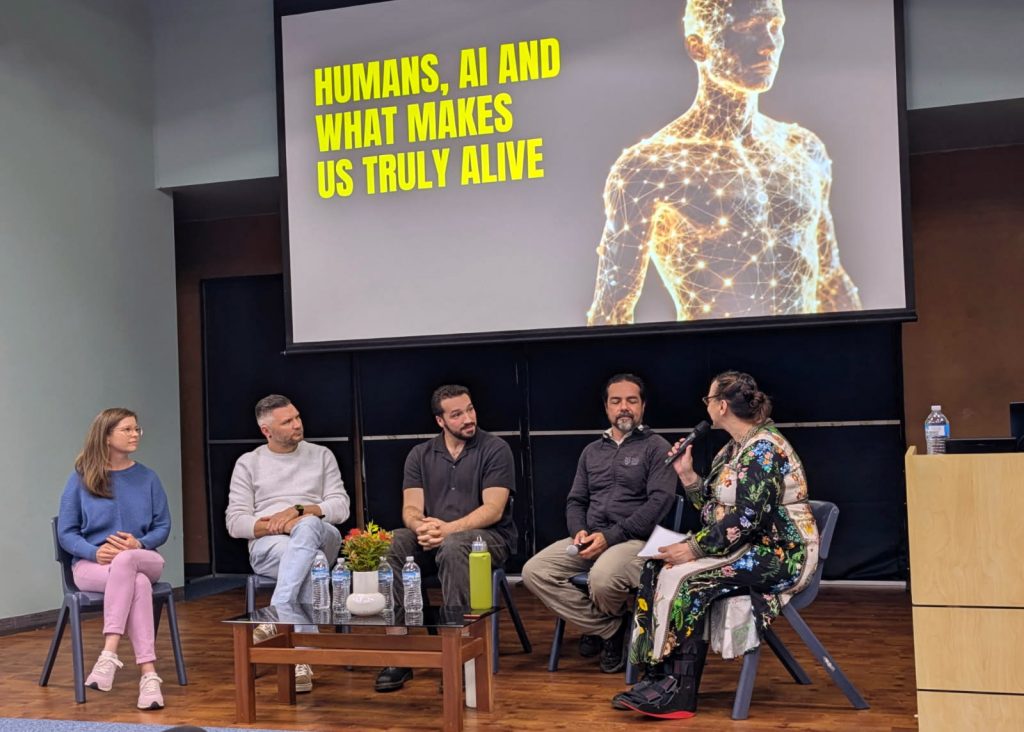
NELSON EULALIO AS GUEST SPEAKER
Nelson Eulalio, as a guest speaker, discussed the role of education in the era of AI, raising concerns about the growing tendency to outsource human creativity to machines. He pointed to the historical roots of the modern education system, arguing that since the Industrial Revolution, people have been conditioned to believe their value is tied to productivity—what they can produce, achieve or output. In a time when AI systems can generate content, art and solutions at unprecedented speed, that belief is being deeply challenged. “When machines can produce faster and more efficiently, many people begin to question their own worth,” he suggested, linking this shift to rising feelings of grief, anger and uncertainty.
Yet his message was not one of despair. Instead, Nelson framed this moment as a reckoning—an opportunity for humanity to reconnect with deeper sources of meaning. He encouraged a return to nature, spirituality and intentional living, asking a simple but profound question: why do we create? Not for output alone, he said, but for meaning. Nelson also pointed to community as part of the solution, emphasising the need for spaces where people can reconnect beyond productivity—while acknowledging that communities themselves may need to adapt to meet the realities of a changing world.
AUDIENCE
Other than the great speech delivered by all five panellists, the audience played an active role throughout the evening, particularly during a lively Q&A session where attendees asked thoughtful and, at times, challenging questions on topics such as trust, authenticity, mental health and creativity in an AI-driven world. Engagement continued beyond the formal program, with attendees staying afterwards to speak with organisers and panellists. Many shared that they felt genuinely inspired—not only by the ideas presented but also by the opportunity to reflect more deeply on their own values and way of living. For organisers, the response confirmed that the event resonated on a personal as well as spiritual, emotional and intellectual level.
A key part of the evening also explored both the restorative and destructive potential of AI in real-world contexts. On one hand, examples were shared of AI being used to detect cancers earlier than human specialists in some medical settings, translation tools enabling instant communication across languages, and accessibility technologies supporting blind, neurodivergent and disabled communities. AI is also playing a role in regenerative agriculture and environmental modelling, helping communities respond to climate and biodiversity challenges, while creative platforms are empowering people to produce films, music, art and even launch businesses with far fewer barriers to entry.
At the same time, concern was raised about the risks: deepfakes and misinformation are making it increasingly difficult to discern truth from manipulation; AI-generated content is flooding social media and reshaping human attention and mental health; and loneliness is rising as artificial companions begin to replace aspects of real human connection. The discussion also touched on the growing concentration of power among a small number of technology companies and the broader cultural risk that people may become more productive but less present, and more digitally connected but less relationally grounded.
Several ideas emerged strongly throughout the evening:
- Human worth beyond productivity
- The risk of outsourcing creativity to machines
- The importance of community and connection
- AI as both disruption and opportunity
- A renewed search for meaning and purpose
- What makes us truly human
- AI, meaning, and identity
- Technology and mental health
- How AI can make business easier
- Creativity, embodiment, and connection
- Hope, ethics, and the future we are building

Humans, AI and What Makes Us Truly Alive sparks reflection and deep conversation with Nelson Eulalio and other guest speakers